
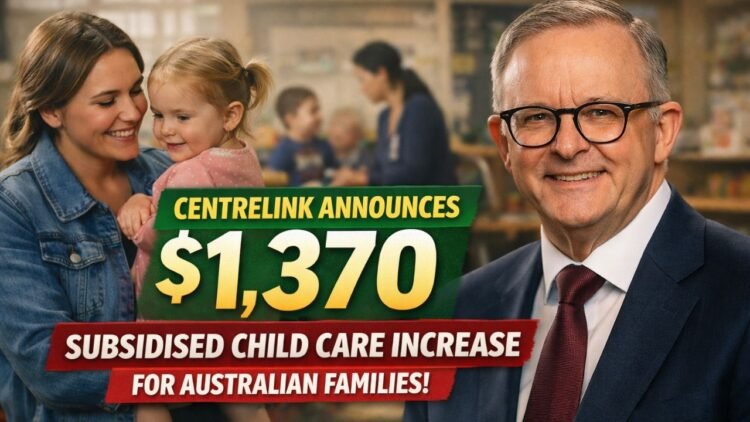
Australian families relying on government-supported child care assistance are set to benefit from a significant financial boost. Centrelink has officially announced a $1,370 increase in subsidised child care support, offering much-needed relief to households managing the ever-growing costs of early childhood education and care across the country.
What Is the $1,370 Child Care Subsidy Increase?
The $1,370 subsidised child care increase represents an upward revision in the Child Care Subsidy (CCS) payment structure administered through Centrelink and Services Australia. This increase is designed to reduce the out-of-pocket expenses that eligible Australian families face when enrolling their children in approved child care services, including long day care, family day care, outside school hours care, and occasional care centres.
The updated subsidy amount reflects the Australian Government’s ongoing commitment to making early childhood education more financially accessible, particularly for low-to-middle income households struggling with rising living costs.
Who Is Eligible for the Centrelink Child Care Subsidy Increase?
Not every family will automatically receive the maximum $1,370 increase. Eligibility for the enhanced Centrelink child care payment depends on several factors, including combined household income, the number of children in care, and the activity level of each parent or guardian.
Families with a combined annual income below $80,000 generally attract the highest subsidy percentage, while those earning between $80,000 and $530,000 receive a progressively reduced rate. Families earning above the upper income threshold may receive minimal or no subsidy support.
To qualify, at least one parent or carer must meet the activity test, which includes activities such as paid work, study, training, or volunteering. Children must also be enrolled in an approved child care service that meets Australian Government standards.
How the Child Care Subsidy Increase Affects Australian Families
The $1,370 boost to the subsidised child care payment will directly lower weekly and fortnightly out-of-pocket costs for eligible families. For many households, this translates into hundreds of dollars saved annually, freeing up income that can be redirected toward other essential expenses such as housing, groceries, and education.
Child Care Subsidy Payment Breakdown Table
Below is a simplified overview of how the updated Centrelink Child Care Subsidy applies across different income brackets following the announced increase:
| Combined Family Income | Subsidy Rate (%) | Estimated Annual Benefit |
|---|---|---|
| Below $80,000 | Up to 90% | Highest benefit tier |
| $80,000 – $160,000 | 85% – 75% | High benefit tier |
| $160,000 – $300,000 | 74% – 50% | Moderate benefit tier |
| $300,000 – $530,000 | 49% – 20% | Lower benefit tier |
| Above $530,000 | Minimal / Nil | Minimal support |
These figures are subject to the individual family’s circumstances and the approved hourly rate cap set for each child care service type.
How to Claim the Centrelink Subsidised Child Care Increase
Families who are already receiving the Child Care Subsidy through Centrelink do not need to reapply to access the updated payment amounts. The increase will be reflected automatically through Services Australia once the updated policy takes effect.
However, families who have not yet applied for the CCS are strongly encouraged to do so through their myGov account linked to Centrelink. The application process involves providing income details, child care service information, and evidence of activity test compliance.
Why the Government Is Increasing the Child Care Subsidy
Australia has experienced a consistent rise in child care fees over recent years, outpacing wage growth and placing considerable pressure on working families. The federal government’s decision to raise the subsidised child care payment by $1,370 is part of a broader policy agenda aimed at supporting workforce participation, especially among women, while ensuring that children receive quality early education.
Research consistently demonstrates that access to high-quality early childhood education improves long-term developmental outcomes for children. By reducing financial barriers to enrolment, the government aims to increase participation rates across all socioeconomic groups.
Impact on Child Care Providers and the Sector
The increased Centrelink child care subsidy is also expected to benefit approved child care providers by attracting more enrolments from families who previously found child care unaffordable. This could lead to improved occupancy rates and financial sustainability across the sector, particularly in regional and remote areas of Australia where access to affordable care has historically been limited.
Child care workers and early childhood educators may also see positive downstream effects, as healthier enrolment numbers support staffing levels and service expansion.